If you’ve lived in California for more than a few years, you know the feeling. You open your mail, see that DMV renewal notice, and there it is: the dreaded “Smog Certification Required” message. It’s enough to make any driver’s heart sink just a little. Whether you’re cruising in a reliable Toyota Camry, a sturdy Ford F-150, or a sleek Hyundai Elantra, the pressure to pass is real.
But as we head into 2026, the rules of the game have shifted slightly. California is tightening its grip on emissions, and if you aren’t prepared, you might find yourself stuck in a loop of failed tests and costly repairs. At One-Stop Auto Cares, we’ve seen it all, and we’re here to help you navigate these updated regulations so you can stay on the road without the stress.
The Big Change in 2026: No More “Incomplete” Passes
For years, California drivers of 1996 and newer vehicles had a little bit of a safety net. The state allowed you to pass a smog check California inspection even if one of your car’s internal “readiness monitors” wasn’t quite ready: specifically the evaporative (EVAP) monitor.
Starting late 2025 and moving into the 2026 cycle, that grace period is effectively over. The Bureau of Automotive Repair (BAR) has moved toward a “zero-incomplete” standard for most gasoline vehicles. This means that if your car’s computer hasn’t finished its self-checks for every single system, you’ll get an automatic “not ready” result.
Think of readiness monitors as a internal checklist your car runs while you drive. If you recently disconnected your battery or cleared a code to get rid of a light, those monitors reset to “zero.” If you roll into a smog station before they’ve finished their cycle, you’re looking at a fail, even if your car is running perfectly.
Why Your Check Engine Light Is a Dealbreaker
We’ve all been there. You’re driving down the 405 or through a quiet neighborhood, and that orange glow pops up on your dash. It might feel like a minor annoyance, but when it comes to a smog check California, that light is a brick wall.
In 2026, the diagnostic standards are more precise than ever. A glowing check engine light is an immediate, automatic failure. But even more frustrating is the “phantom” light: when the light is off, but a “permanent code” is still stored in the computer’s memory. California’s newer Smog Check specialized software can see these hidden codes.
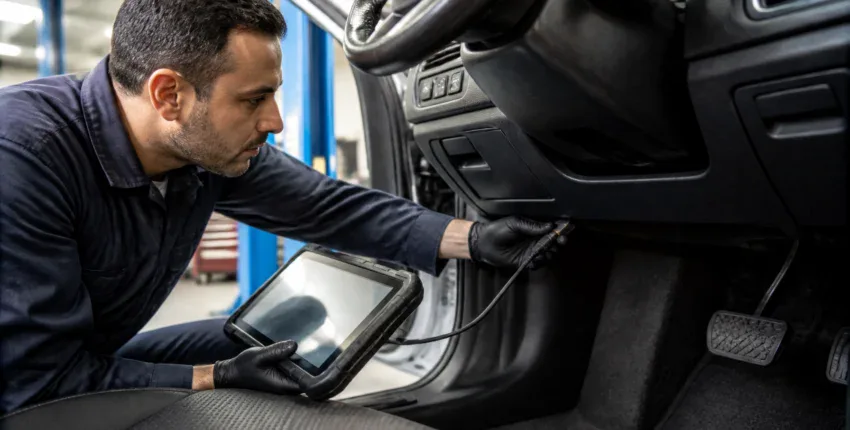
If you’re seeing that light, don’t wait until the week your registration expires. At One-Stop Auto Cares, we offer free check engine light diagnostic code readings to help you understand exactly what your car is trying to tell you. Knowing if it’s a loose gas cap or a failing oxygen sensor early on can save you hundreds in “emergency” repairs later.

Sensory Cues: Being Your Own Detective
Before you even book an appointment for auto repair near me, you can use your own senses to gauge if your vehicle is ready for the 2026 standards. Your car often gives you warnings long before a sensor triggers a code.
The Smell Test
Do you notice a faint scent of rotten eggs when you’re idling? That’s often a sign that your catalytic converter is struggling to process the exhaust gases. If you smell raw gasoline, you might have an EVAP leak: a common reason for failing the new, stricter readiness checks.
The Sound Test
Listen to your engine when it’s cold. Do you hear a rhythmic “hissing” sound? That could be a vacuum leak. Modern Asian and domestic vehicles rely heavily on precise air-to-fuel ratios. A tiny leak can cause your engine to run “lean,” which might not trigger a light immediately but will definitely cause an emissions failure during the high-tech 2026 inspections.
The Feel Test
If your car feels sluggish or “stutters” when you’re accelerating onto the freeway, your spark plugs or ignition coils might be nearing the end of their life. Poor combustion leads to higher tailpipe emissions, making it much harder to pass the comprehensive smog check standards required today.
Specialized Care for Asian and Domestic Brands
At One-Stop Auto Cares, we specialize in the brands that keep our community moving: Toyota, Honda, Nissan, Hyundai, Kia, Ford, Chevy, and Chrysler. While the smog rules are the same for everyone, the way these cars respond to them can differ.
For example, many Honda and Toyota models have very specific “drive cycles” required to set those readiness monitors we mentioned earlier. Simply driving around the block won’t do it. You might need to maintain a steady 55 mph for several miles, then let the car idle, then accelerate again.
Domestic trucks, like the Ford F-Series or Chevy Silverado, often face issues with their secondary air injection systems as they age. These components are vital for passing the 2026 visual and functional inspections. Because we focus on these specific makes, we know exactly what to look for and how to fix it the first time.
Preparing for Success: A Quick Checklist
If your smog check is coming up, here is the best way to ensure you pass on the first try:
- Don’t clear your codes right before the test. If you or a friend use a cheap scanner to turn off the light, you’ve just reset your monitors. You’ll fail for “not being ready.”
- The Two-Week Rule. Try to get any necessary repairs done at least two weeks before your test. This gives you plenty of time to complete several “cold-to-hot” drive cycles.
- Check your gas cap. It sounds simple, but a cracked rubber seal on your gas cap is one of the most common reasons for an EVAP failure.
- Drive it hot. On the day of your test, drive your car for at least 20 minutes on the freeway. This ensures the catalytic converter is at its optimal operating temperature when the technician starts the test.
- Address the “Check Engine” light immediately. If it’s on, you’re going to fail. Period. Use a check engine light diagnostic to identify the root cause.
Making Quality Care Affordable
We know that car repairs can be a sudden, unwanted expense. If your car needs a significant repair to pass its 2026 smog check: like a new catalytic converter or fuel system overhaul: don’t panic.
We’re committed to keeping our community on the road, which is why we offer flexible financing options through EasyPay Finance and Snap Finance. These programs allow you to break down the cost of essential repairs into manageable monthly payments. Our goal is to take the “stress” out of “stress-test.”
Additionally, if you’ve had a “near miss” or just want to be sure you’re doing things right, check out our guide on avoiding smog retests. It’s packed with details on OBD readiness that are more relevant now than ever.
Trust the Local Experts
Navigating California’s emissions laws doesn’t have to be a nightmare. By staying proactive and paying attention to your vehicle’s warning signs, you can breeze through your 2026 inspection.
If you’re searching for a reliable auto repair near me to handle your smog needs, look no further. Whether it’s a routine oil change to keep things running clean or a deep dive into why your light is on, our team at One-Stop Auto Cares is ready to help.
Give us a call or book your appointment today. Let’s make sure your car is ready for the road and the law!