
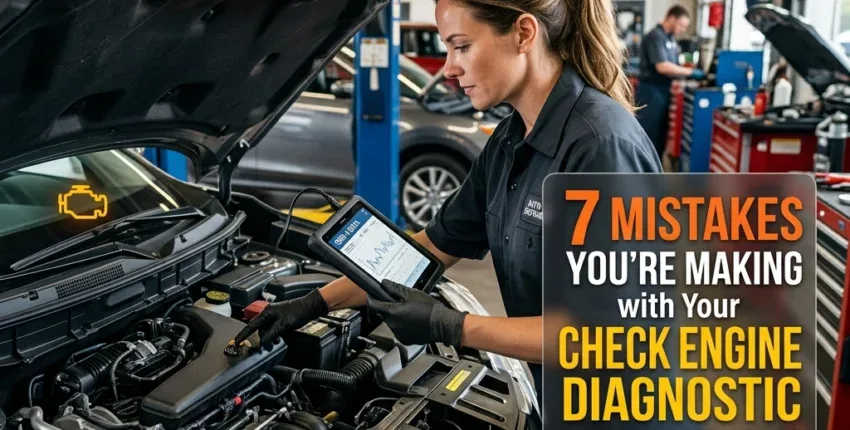
We’ve all been there. You’re cruising down the road, your favorite song is on the radio, and life is good. Then, out of the corner of your eye, you see it: that little orange glow on your dashboard. The dreaded Check Engine Light (CEL).
It’s like a tiny, glowing ghost that appears just to ruin your afternoon. Your stomach drops, your mind starts racing toward “how much is this going to cost?” and suddenly, you’re tempted to do one of two things: panic or pretend it isn’t happening.
At One-Stop Auto Cares, we see hundreds of these lights every month. And while that light can be stressful, the biggest stress usually comes from the mistakes drivers make after it turns on. Most of the time, the fix is simpler than you think, if you handle it the right way.
Let’s walk through the seven most common mistakes drivers make with their check engine light diagnostics and, more importantly, how you can fix them without losing your mind (or your savings).
1. The “If I Ignore It, It Will Go Away” Strategy
This is the most common mistake by far. It’s human nature, we hope that if we ignore a problem, it’ll eventually solve itself. But when it comes to your car’s computer, hope isn’t a maintenance strategy.
Ignoring the light is like ignoring a persistent toothache. Sure, you can chew on the other side of your mouth for a while, but eventually, you’re looking at a root canal. When your car’s computer triggers that light, it means a sensor has detected something “out of spec.” If you keep driving, a small problem (like a $20 sensor) can turn into a massive problem (like a $2,000 catalytic converter replacement).
The Fix: Treat the light as a “friendly heads-up” rather than an emergency siren. The sooner you check it, the cheaper the repair usually is. If you’re worried about the cost of just finding out what’s wrong, remember that we offer free diagnostic code readings to get you started.
2. Mistaking “Steady” for “Flashing”
Did you know your check engine light has a “language” of its own? Most people don’t realize there’s a massive difference between a light that stays on and one that blinks.
- Steady Light: This means there is a problem, but it’s not an immediate “blow up your engine” situation. You should get it checked soon, but you don’t necessarily need a tow truck right this second.
- Flashing Light: This is the car equivalent of a 911 call. A flashing light usually indicates an “engine misfire” so severe that unburned fuel is getting dumped into your exhaust system. This can melt your catalytic converter in minutes.
The Fix: If the light is flashing, pull over immediately and turn off the engine. If it’s steady, you’re likely safe to drive it to a shop, but don’t wait weeks. You can learn more about why your check engine light is on to help identify the urgency.

3. Clearing the Code Without Fixing the Issue
With the rise of cheap OBD-II scanners you can buy online, many drivers have started “playing mechanic.” They plug in the tool, see a code, and hit “Clear.” The light goes away, and they feel like a genius.
The problem? Clearing the code is just deleting the “message,” not fixing the “problem.” The car’s computer will eventually realize the issue is still there and turn the light back on: usually right when you’re headed to your California smog check.
The Fix: Use the code as a starting point for a repair, not as a “delete” button. If you clear the codes right before an emissions test, your car’s “Readiness Monitors” won’t be set, and you’ll fail the test anyway. Check out our guide on California smog retest avoidance to see why clearing codes can actually make things harder.
4. The “Parts Cannon” Approach
This is another favorite for DIYers. You get a code that says “Oxygen Sensor Bank 1,” so you go to the parts store, buy an O2 sensor, and swap it out. The light stays on. So you buy another part. Then another. This is called “firing the parts cannon,” and it’s an expensive way to fix nothing.
A code doesn’t tell you which part is broken; it tells you which system is seeing a problem. For example, a “Lean” code could mean a bad sensor, but it could also mean a simple vacuum leak or a dirty air filter.
The Fix: Proper diagnostics involve testing the component before replacing it. At One-Stop Auto Cares, we don’t just read the code; we verify the failure. This saves you from buying parts you don’t actually need.

5. Overlooking the Gas Cap (The $15 Fix)
Believe it or not, one of the most common reasons for a check engine light is a loose, cracked, or faulty gas cap. Your car’s fuel system is pressurized to prevent gasoline vapors from leaking into the atmosphere. If the cap isn’t sealed tight, the computer thinks there’s a leak in the “Evaporative Emissions (EVAP)” system.
The Fix: If your light just came on, the first thing you should do is pull over and make sure your gas cap is clicked into place. If the cap looks old or the rubber seal is cracked, try replacing it with a new one. It might take a few days of driving (a “drive cycle”) for the light to reset itself, but it’s the easiest fix in the book.
6. Assuming It’s Always Something Expensive
We hear it all the time: “I didn’t bring it in because I was afraid I’d need a new engine.”
This fear keeps people from getting help, which ironically leads to more expensive repairs. In reality, many check engine light issues are related to sensors, spark plugs, or small maintenance items. For instance, a light might trigger because your engine is overdue for an oil change service, affecting the variable valve timing.
The Fix: Don’t let “repair anxiety” stop you. Most CEL fixes are manageable. If it does turn out to be something significant, we have your back. We offer helpful financing options like EasyPay and Snap Finance to help you break that cost down into bite-sized monthly payments. Your safety is worth more than the stress of a big bill.

7. Skipping the “Customer Interview” (Even with Yourself!)
When you go to a shop (or even when you’re trying to figure it out yourself), the most important piece of data isn’t the code: it’s the context.
Did the light come on right after you hit a big pothole? Did it start after you filled up at a different gas station? Does the car shake when the light comes on? Many drivers forget these details, but they are the “breadcrumbs” that lead a mechanic to the fix much faster.
The Fix: When the light comes on, take a mental note of:
- How the car feels (Is it vibrating? Losing power?)
- What you were doing (Idling at a light? Speeding on the highway?)
- Any recent services (Did you just get a brake replacement or battery change?)
Sharing these details with your technician can cut diagnostic time in half.
Why Choose One-Stop Auto Cares for Your Diagnostic?
We know that a dashboard light feels like a dark cloud over your day. But at One-Stop Auto Cares, we’re all about clearing the air.
We don’t believe in high-pressure sales or confusing jargon. We believe in being a comprehensive solution for your vehicle’s health. When you bring your car to us, we start with a free code reading to give you immediate peace of mind. From there, our expert team uses high-end diagnostic tools to pinpoint the exact issue so you aren’t wasting money on unnecessary repairs.
Whether it’s a simple tune-up or a complex electrical issue, we’re here to help you get back on the road safely and affordably.
Ready to turn that light off for good?
Don’t wait for a small sensor to become a big headache. Come see us today, or contact us to schedule a time to stop by. Let’s get your car back to its happy, “non-glowing” self!
P.S. Worried about the budget? Ask us about EasyPay or Snap Finance when you arrive: we’ll find a way to make it work for you!